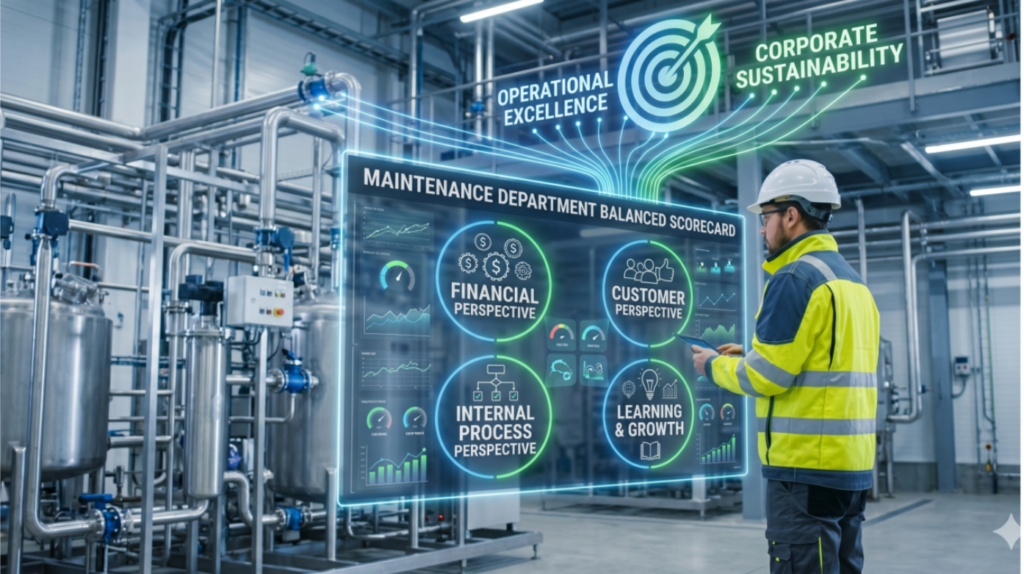
A balanced scorecard provides a structured approach to evaluating maintenance performance across financial, customer, internal process, and learning & growth perspectives. For manufacturing, this framework helps align maintenance strategies with organizational goals, ensuring operational excellence and long-term sustainability.
(1) Financial Perspective: How maintenance is affecting the company’s money?
Financial perspective checks whether maintenance is helping the plant run reliably at the right cost, without wasting money.
It mainly looks at questions like:
- Are you controlling maintenance costs?
- Are you avoiding big losses due to breakdowns and downtime?
- Are you using spares, manpower, and budgets properly?
- Are your assets giving good value for the money spent on them, return on investments
Below are the key indicators to track maintenance financial performance:
- Maintenance Cost per Unit Product Produced
- Budget Adherence Rate
- Asset Return on Investment (ROI)
- Percentage of Emergency Maintenance
- Spare Parts Inventory Turnover
(2) Customer Perspective: How happy your “customers” are with maintenance service?
Customer perspective checks whether maintenance is meeting the expectations of the people who depend on maintenance.
For a maintenance department, the “customers” are usually:
- Operations/Production team (they need machines to run)
- Plant management (they need good uptime and results)
- Safety and Quality teams (they need safe and stable equipment)
It mainly asks:
- Are we giving reliable equipment with minimum breakdowns?
- Are we responding fast when there is a problem?
- Are we supporting smooth production without delays?
To understand how satisfied your internal customers are, you can track the below indicators:
- Equipment Reliability Index
- Average Downtime per Critical Asset
- Maintenance Response Time
- Number of Customer Complaints Related to Equipment
(3) Internal Processes Perspective: How well your maintenance work is happening inside the department, your processes, systems, and day-to-day execution.
Internal process perspective checks whether maintenance is being done in the right way, in a planned and efficient manner, to keep equipment healthy and reliable.
It answers questions like:
- Are we doing preventive maintenance on time?
- Are breakdowns reducing?
- Are we planning jobs properly, or doing only emergency work?
- Are work orders, spares, permits, and shutdown jobs getting completed smoothly?
To understand how well your maintenance processes are working, you can track the below indicators:
- Preventive Maintenance Compliance
- Number of Breakdowns
- Percentage of Planned vs. Unplanned Maintenance
- Asset Health Index
- Maintenance Labor Productivity
(4) Learning & Growth Perspective: How well your maintenance team is improving or getting ready for the future.
Learning & Growth checks whether your people and capabilities are becoming stronger, so maintenance performance will improve year after year.
It looks at things like:
- Are technicians getting proper training including modern days digital skills?
- Are people building the right skills and certifications?
- Are we improving safety culture and good work practices?
- Are employees involved in continuous improvement (new ideas, problem solving, better ways of working)?
To measure learning and growth in your maintenance team, you can track the below KPIs:
- Training Hours per Maintenance Staff
- Skill Certification Rate
- Safety Incident Rate
- Employee Engagement in Continuous Improvement Initiatives
- Digital use cases implemented and adoption rate
Summary:
Using a balanced scorecard helps maintenance teams in manufacturing track the most important KPIs in all key areas. This full view helps the team take early decisions, improve equipment reliability, and build a habit of continuous improvement. Finally, it supports safe and efficient operations.
The balanced scorecard is important because it gives a clear structure and links maintenance goals with the company’s overall strategy. When we track performance in financial, operations, and learning areas, we can make sure maintenance work is supporting company goals like profit, safety, and improvement.
This connection gives better clarity to management. It helps convert the company vision into clear targets and check progress regularly. Because of this, maintenance teams can support long-term sustainability and help the company stay competitive.
Test comment