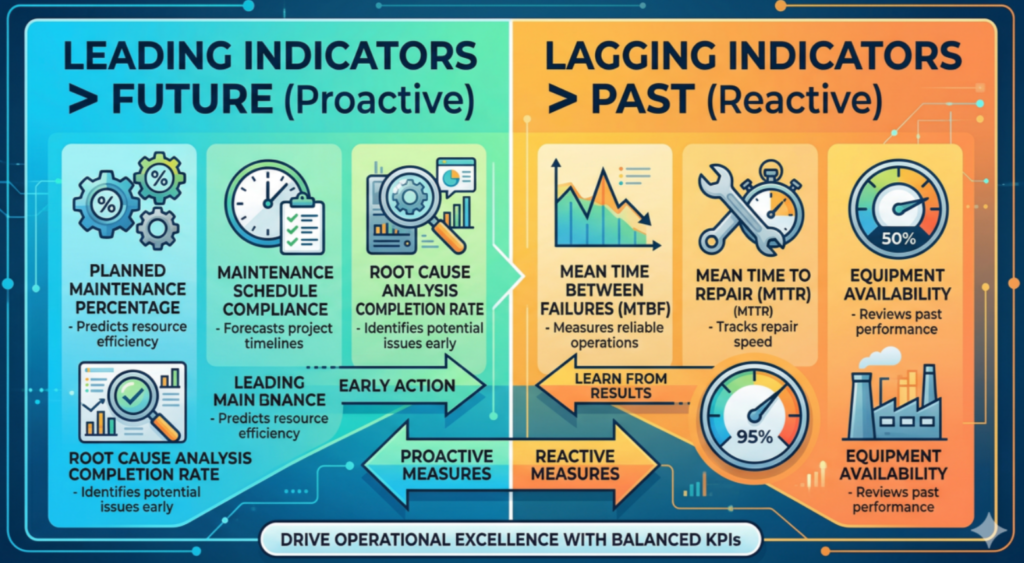
Leading indicators > FUTURE > are proactive measures, which means they help predict how things might go in the future. These indicators warn us about possible issues before they actually happen, allowing teams to take action early and avoid problems.
Lagging indicators > PAST > on the other hand, are reactive measures. They show us the results of things that have already happened. By looking at these indicators, teams can understand what went well or what went wrong, and learn from past events.
Leading Indicators
Planned Maintenance Percentage: The proportion of total maintenance hours spent on planned (preventive or predictive) activities versus unplanned work.
Example: If a team spends 120 hours in a month on planned maintenance and 80 hours on unplanned repairs, the Planned Maintenance percentage is 60% (=120/200*100).
Maintenance Schedule Compliance: The percentage of scheduled maintenance tasks completed within the planned time frame.
Example: If 50 out of 60 scheduled tasks were finished as planned in April, the schedule compliance rate is around 83%.
Preventive Maintenance Compliance (PM Compliance): The ratio of completed preventive maintenance jobs to those scheduled within a specific period.
Example: Completing 90 out of 100 scheduled preventive tasks in a month yields a compliance rate of 90%.
Work Order Backlog: The total amount of pending maintenance work, measured in labor hours or days, that is yet to be completed.
Example: A backlog of 200 man-hours indicates the team needs 200 more hours to clear all pending jobs.
Training Hours per Technician: The average number of hours spent on technical training per technician within a given period.
Maintenance Response Time: Time taken to begin addressing a maintenance request after it is logged.
Root Cause Analysis Completion Rate: Percentage of breakdowns or failures for which thorough root cause analysis has been completed.
Lagging Indicators
Mean Time Between Failures (MTBF): The average time elapsed between one failure and the next for a equipment.
Example: If a pump fails every 500 operating hours on average, its MTBF is 500 hours.
Mean Time to Repair (MTTR): The average time taken to repair a failed asset and return it to normal operation.
Example: If it takes an average of 2 hours to fix a machine after a breakdown, the MTTR is 2 hours.
Equipment Availability: The percentage of time equipment is available and ready for use compared to the total scheduled operating time.
Example: If a generator is operational for 700 out of 730 scheduled hours in a month, its availability is approximately 95.9%.
Maintenance Cost per Unit of Production: The total maintenance cost divided by the number of units produced within a period.
Example: Spending ₹2,00,000 on maintenance to produce 1 lakh units results in a cost of ₹2 per unit.
Number of Breakdowns: The count of unplanned equipment failures in a given period.
Spare Parts Inventory Turnover: Rate at which spare parts are used over a defined period; high turnover can indicate efficient inventory management.
Percentage of Emergency Maintenance: Share of maintenance tasks that are urgent or unplanned versus total maintenance activities.
Asset Health Index: Composite metric that reflects the condition and performance of assets based on age, maintenance history, inspections, and sensor data.
Maintenance Resource Productivity: Measures output per maintenance staff, such as completed work orders per technician per month.
Conclusion
Tracking both leading and lagging indicators is vital for maintenance business transformation. Leading indicators provide early warnings and guide preventive actions, while lagging indicators measure results and highlight areas for long-term improvement. Monitoring a balanced set of KPIs enables maintenance professionals to drive operational excellence and achieve sustainable success.