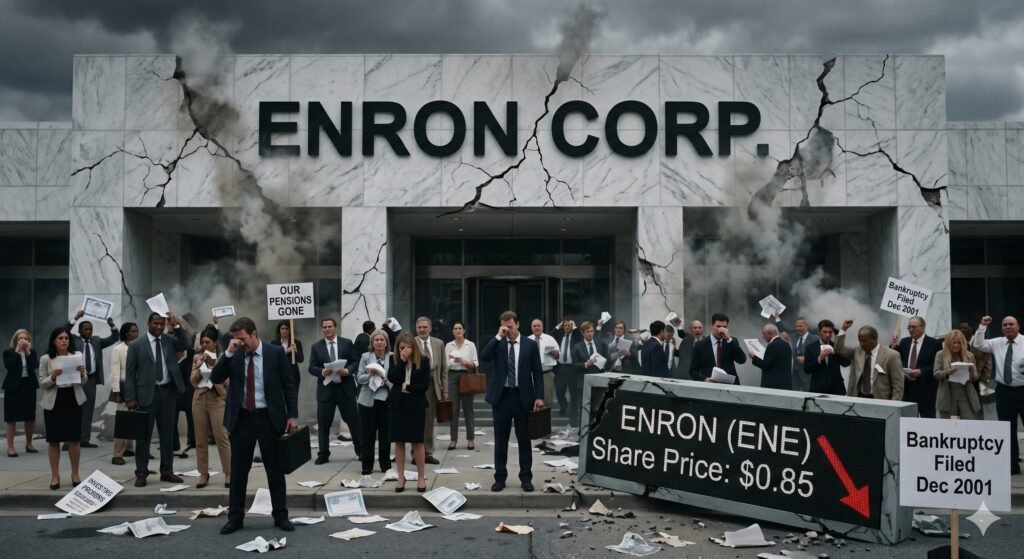
Enron is a well-known example of how accounting practices can mislead investors. The company was formed in 1985 and first worked in the natural gas pipeline business. Later, it became a major energy trading company and was widely praised for its fast growth and new business ideas. At its peak, Enron appeared to be a very successful company with high revenue, business expansion, and a bright future. Because of this image, many investors believed that the company was financially strong and safe for long-term investment.
Main Problem
The main problem was that Enron’s financial statements did not show the real condition of the company.
- It used mark-to-market accounting to record expected future profit as current profit.
- It also used special purpose entities (SPEs) and off-balance-sheet methods/tricks to move debt and loss making assets out of the main accounts.
Impact on Profit and Share Price
These accounting methods made Enron’s financial performance look stronger than it really was. Revenue, income, and profit appeared higher, while some losses and expenses were delayed or kept out of view. As a result, many investors believed that Enron was performing very well and continued to buy its shares. This kept market confidence and the share price high for some time. However, when the true position became known, investor trust fell sharply and the share price collapsed.
- Debt-equity ratio: Because some debt was kept outside the main accounts, the company looked like it had less debt and a better financial position.
- Revenue growth: Revenue looked strong and fast-growing, so people thought the business was expanding well.
- Profit growth: Reported profit looked higher because future gains were recorded early and some losses were delayed.
- Earnings per share (EPS): Higher reported profit made EPS look better, and many investors use this as an important measure.
- Return ratios (ROE, ROA): Return on equity and return on assets looked stronger because the accounts showed better earnings than the real business position.
- Share price trend: Because the company looked profitable and financially strong, investor confidence remained high and the share price kept rising for some time.
To understand these methods more clearly, the table below briefly compares the main accounting approaches.
| Accounting method | Meaning | Advantages | Disadvantages |
| Mark-to-market | Assets or contracts are valued using current market value or estimated present value of future gains. | It shows current value quickly and is useful in active trading markets. | It can depend too much on estimates, may record profit too early, and can mislead investors if used aggressively. |
| Fair value | Assets and liabilities are measured at the price for which they can be sold or transferred in the current market. | It gives updated values and helps people understand the current financial position. | It can become subjective when markets are weak and values can change often. |
| Historical cost | Assets and liabilities are recorded at original purchase cost unless rules require a change. | It is simple, easy to understand, and based on actual transaction value. | It may not show the current market value and may be less useful for present decisions. |
When the truth started coming out in 2001, investor confidence fell very quickly. Enron announced major losses, its share price fell from more than $90 to less than $1, and many investors, employees, and pension holders suffered heavy losses. The company filed for bankruptcy in December 2001.
Profit, Debt and LJM Transactions
Enron’s annual reports showed fast growth in revenue, profit, and assets. The figures below show why many investors believed that the company was becoming stronger year by year.
| 1999 | 2000 | |
| Revenue | $40,112 million | $100,789 million |
| Total net income | $893 million | $979 million |
| Total assets | $33,381 million | $65,503 million |
These figures made Enron look like a company with strong growth and healthy profits. But this picture was incomplete because important risks were being moved outside the main accounts.
One major reason for this gap was Enron’s use of special purpose entities. Through LJM1, LJM2, and other entities, Enron kept some debt, risky assets, and losses outside the company’s main financial statements.This made the company look less risky than it really was. These entities bought assets from Enron, took on risky exposures, and allowed Enron to record gains or avoid losses in its own books. In this way, Enron showed a stronger financial position than the real one.
Overall, Enron’s reports showed rising revenue, profit, and assets on paper, while important debt-related risks were being shifted through LJM and other entities. This gap between reported performance and the real financial condition is the main reason why investors were misled. The case shows that investors should examine not only revenue and profit, but also cash flow, debt, related-party transactions, and disclosures.
The main lesson for investors is simple: they should not trust accounting numbers blindly. They should ask how the numbers were prepared, what assumptions were used, and whether cash flow and disclosures support the company’s claims.
The case also highlights the role of corporate governance. Weak oversight made the problem worse. The board did not question management properly, the auditor was not fully independent, and internal controls were weak. Because of these failures, the misleading reporting continued for a long time.
The main lesson for independent directors is that they should not remain only formal board members.
- Too much complexity: If the business model, accounts, or transactions are very difficult to understand, directors should ask for a clear explanation.
- Related-party transactions: Deals involving promoters, senior management, or connected entities should be checked carefully for conflict of interest.
- Off-balance-sheet items: If debt, losses, or obligations are kept outside the main financial statements, it is a major warning sign.
- Profit without cash flow: If profit is rising but operating cash flow is weak, directors should question the quality of earnings.
- Pressure for quick approval: If management pushes the board to approve complex decisions without enough time or information, directors should be careful.
- Weak auditor independence: If the auditor is too close to management or also receives large non-audit fees, board oversight can become weak.
- Poor internal controls: Repeated control failures, unclear reporting lines, or weak compliance systems should not be ignored.
- No open challenge culture: If employees, auditors, or board members are discouraged from asking questions, it is a serious governance risk.
In conclusion, the Enron case shows how false accounting, hidden debt, and weak corporate governance can destroy even a large company. It remains an important lesson for investors, directors, and regulators to examine financial information carefully and act responsibly.